
When you rent out heavy equipment or other valuable tools, you open your business to many financial risks. Incidents like accidental damage, misuse, and theft can result in damage to your costly equipment or your client may hold you liable for any bodily injury caused by it.
Equipment rental insurance thus becomes a must to protect your business against these risks. If you’re wondering how exactly it protects your equipment and business, what it covers, and how much equipment rental insurance coverage will cost you, then this guide by AOR Insurance is a must read for you.
Let’s start with the basics
Equipment rental insurance comes under the Inland Marine insurance which protects your movable property that may be transported, stored off-site, or used away from a permanent business location. It protects you against any financial loss related to your rental equipment.
It covers the cost of repairing/ replacing the equipment you’ve rented in case it’s lost, stolen, or damaged on the job.
The standard policy for rental equipment insurance covers:
Equipment rental insurance does not generally cover:
If you’re in the business of renting out your equipment for specific projects or if you rent equipment for your business or specific events then you need equipment rental insurance coverage to protect you.
If you lend/ lease out inventory (such as heavy machinery, party supplies, or medical tools), then you need this protection as you lose direct control over these items once they leave your premises.
Builders who rent expensive machinery like backhoes, cranes, or bulldozers often need coverage or a certificate of insurance (COI) to satisfy their rental agreements and protect against jobsite theft or damage.
You can also check our guide to understand your construction insurance coverage needs.
Businesses handling movable, high-value inventory like audio/visual gear, party tents, or staging that gets transported and set up off-site also need this coverage.
If you’re still unsure about your insurance needs, get in touch with us at (866) 685-0661 to discuss what policies are relevant for you.
While rental equipment insurance isn't universally required by law for every rental transaction, it may be required by a rental agreement, lender, project owner, or a general contractor.
You may be asked to provide proof of coverage when:
The biggest reason to carry rental equipment insurance is quite simple, equipment losses can become very expensive and without appropriate insurance, you may have to pay for the loss out of your own funds.
Your insurance for rental equipment can therefore help you:
Now that you know what all equipment rental insurance covers and why and when it’s needed, let’s discuss the policies that come under it. Depending on the equipment you deal with and their transportation requirements, you may need a combination of the following policies.
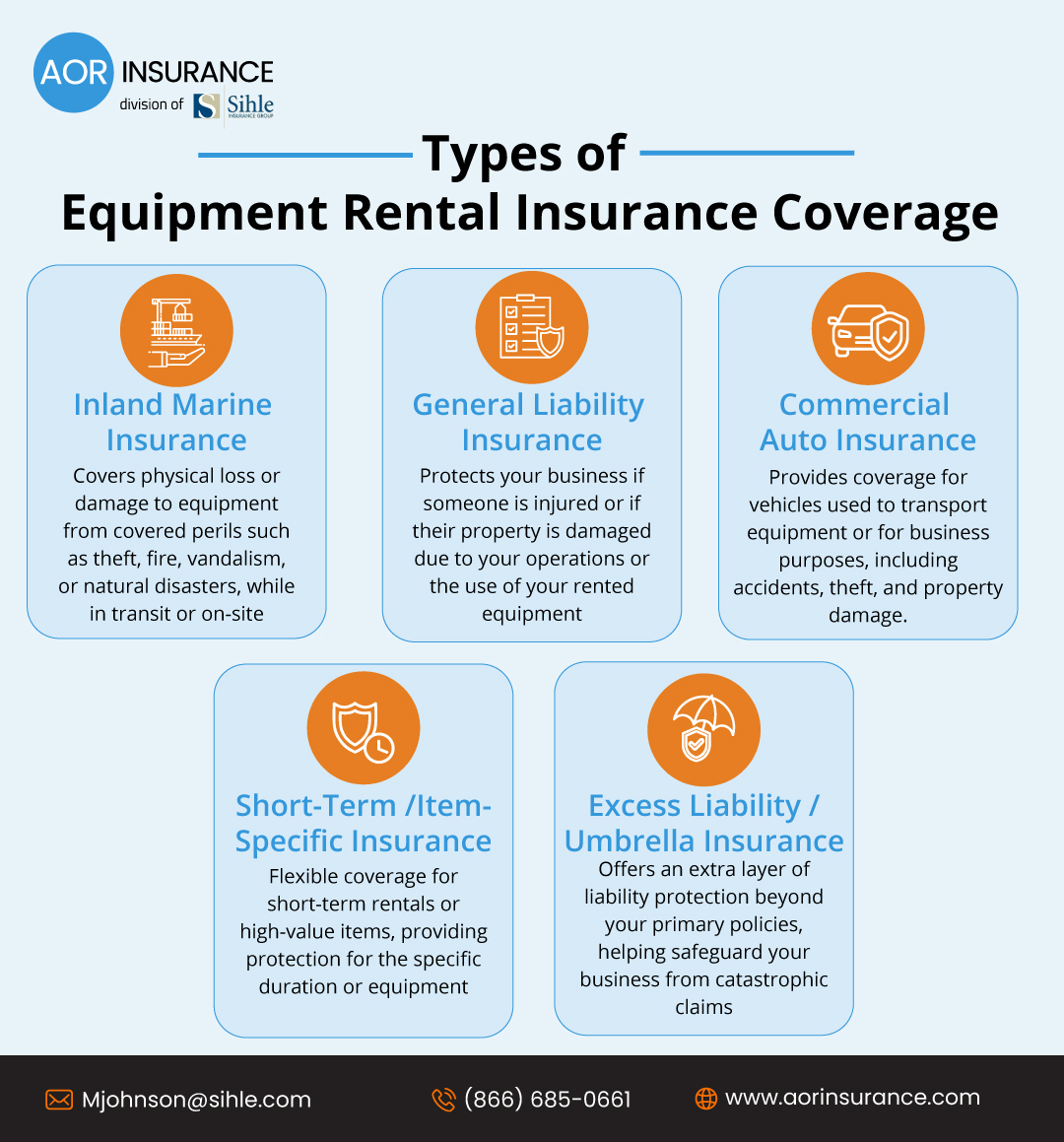
Protects the physical asset or your rented machine against theft, vandalism, fire, or collision while it is in transit or at a jobsite.
Covers third-party bodily injury and property damage that’s caused by the operation of your rented equipment. It typically excludes the damage to the equipment itself.
This insurance coverage is necessary if you’re towing heavy machinery or driving rented vehicles (like boom trucks or dump trucks) on public roads. It covers vehicular accidents during transport.
This policy provides customizable, project-specific coverage for distinct periods or specialized gear like cameras and party supplies.
It increases your maximum payout limits beyond underlying policies to protect against large, costly claims.
If you own a construction company or work as a contractor, here's a guide to the nine construction insurance risks that you must know.
There is no standard price for equipment rental insurance. Your premium can depend on factors such as:
As there are many variables, don’t just rely on a generic estimate. Get a quote based on your actual equipment and business operations.
When it comes to deciding your rental equipment coverage, the cheapest policy isn't necessarily the best one. What you need is your policy to reflect how your business actually uses and handles equipment.
Here’s a list of factors that you should consider before choosing your coverage:
The insurance professionals at AOR Insurance can help you identify coverage gaps and coordinate your policies around the way your business actually operates.
If you're a contractor or business renting equipment, don't wait until after you’ve signed your rental agreement to think about insurance.
Before taking possession of the equipment, check:
Knowing these requirements before the equipment leaves the rental company can help you prevent any unpleasant/costly surprises later.
Even businesses that have insurance can still have coverage gaps. Here are some common mistakes to watch for:
General liability is designed primarily for certain third-party liability exposures. It shouldn't automatically be treated as physical damage insurance for your equipment.
Think about your maximum potential exposure and not just the value of a single machine.
Your business may grow quickly and your equipment schedule should keep pace with it. Failure to properly report any newly acquired equipment when required by your policy can create problems while you make a claim.
Your insurance policy and rental contract work differently. Understand your contractual responsibilities before taking possession of expensive equipment.
You may lean towards a lower premium but it often comes with lower limits, higher deductibles, narrower coverage, or more exclusions. Compare the protection you're actually receiving rather than looking at price alone.
Whether you operate an equipment rental business or regularly rent machinery for your own projects, you need equipment rental insurance.
It offers protection for mobile and valuable equipment against covered risks such as theft, accidental damage, fire, and other covered causes of loss. It can also help address exposures associated with equipment being transported, stored off-premises, or used at customer locations.
The right coverage depends on your business, the equipment you own/ rent, where it is used, how it is transported, your contractual obligations, and your existing insurance program. At AOR Insurance, we understand these factors and help you get the right coverage. Contact us to discuss your insurance needs.
You need inland marine insurance for equipment rental to cover the cost of replacing/ repairing in case of theft, loss, or damage. You can combine it with General Liability for third-party bodily injury or property damage.
Yes, equipment rental insurance covers theft whether it’s from a job site, a storage facility, or it occurs during transport of the equipment.
The cost of equipment rental insurance depends a lot on the specific policies you choose. The replacement cost of equipment, type of machinery, coverage duration (short-term vs year long commitment), security measures, and your previous claims history also affects this cost.
Yes, individuals can get equipment rental insurance or short-term coverage for tools, cameras, and machinery that they’re renting. But it’s important that you check your specific policy limits and deductibles before relying on it for high-value rentals.
If your rented equipment is stolen, you’re financially responsible for full replacement/ repair costs. Your equipment rental insurance coverage can help you from financial loss in this case.

AOR - Division of Sihle Insurance
We typically reply in a few minutes